
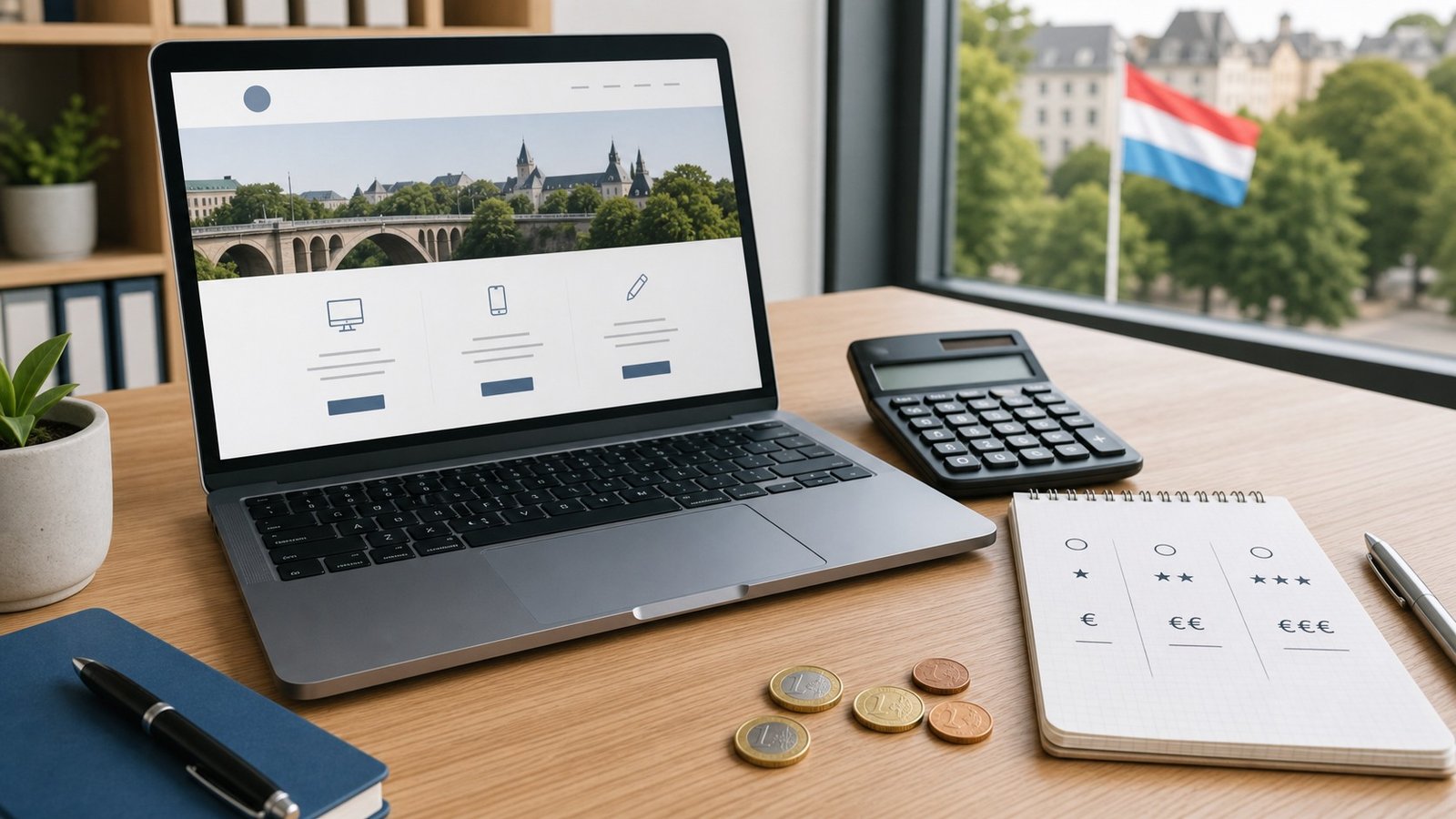
It is the question every Luxembourg business owner asks first — and the one most agencies dodge with "it depends". So let us be the ones who answer it honestly. Below are real price ranges for 2027, exactly what each tier gets you, the five things that move the number up or down, the ongoing costs nobody mentions, and how to avoid the traps that cost you far more than they save.
The short answer (real ranges)
In Luxembourg in 2027, a simple professional website of 3–5 pages typically runs €900–€2,500. A larger business site with custom design and more pages lands around €2,500–€6,000. A full e-commerce store usually starts near €4,000 and climbs with the number of products, payment methods, and integrations. Anything advertised under €500 is almost always a generic template with your logo dropped on top — and it usually costs you more in lost customers than you saved.
What each price tier actually gets you
At the entry level you get a clean, mobile-friendly brochure site: a few pages, a contact form, basic SEO, hosting and SSL. In the mid range you add custom design built around your brand, more pages, lead-capture forms, analytics, WhatsApp integration, and stronger on-page SEO. At the premium level you get a fully bespoke build: a content dashboard you can edit yourself, multilingual support, custom integrations (booking, CRM, payment), and priority support. The right tier depends on how central the website is to winning customers.
The five things that actually move the price
One: how many pages and how much genuinely custom (versus template) design you want. Two: whether you sell online — e-commerce adds product management, payments, and tax handling. Three: multilingual — French, German and English are common in Luxembourg and genuinely worth it, but each language adds content and testing. Four: how much copywriting and photography you need us to produce versus supply yourself. Five: integrations — booking systems, CRMs, or custom features that connect your site to the tools you already use.
One-off cost vs the ongoing cost nobody mentions
The build is a one-time cost. After launch you should budget for hosting, a domain, SSL and maintenance — realistically €15–€60 per month depending on the plan and how often you update content. Skipping maintenance is how sites get hacked, break after a browser update, or quietly slide down Google. A small monthly care plan is far cheaper than an emergency rebuild.
Beware the "free website" and €0-upfront traps
Offers that build your site for "free" or €0 upfront almost always lock you into an expensive multi-year monthly contract — and you usually do not own the site at the end. Over three years these deals frequently cost two to three times what buying outright would have, and leaving means starting from scratch. Always ask: do I own the website and the domain, and what happens if I stop paying?
Why the cheapest quote is rarely the cheapest
A €400 website that loads slowly, looks generic, and never appears on Google costs you customers every single day — that is the real, hidden price. A well-built site that ranks locally and converts visitors pays for itself with a single new client. The honest way to judge a quote is not the invoice total but the leads and revenue the website is likely to generate.
DIY builder vs agency — the three-year maths
A DIY builder like Wix or Squarespace looks cheap at roughly €15–€30 a month. But add the premium apps you will end up needing, the hours you spend fighting the tool, and the customers a generic, slower template quietly loses — and over three years it is often not cheaper than a professionally built site that simply works. If your website only needs to exist, a builder is fine. If it needs to win customers, an agency usually wins on total cost.
What a proper quote should include
A trustworthy quote is fixed-price and itemised: design, development, content, hosting setup, SSL, basic SEO, launch, and training — with nothing important hidden as a "later add-on". You should know the price, the timeline, and exactly what is and is not included before any work begins.
How to get an honest number for your project
The fastest route to a real figure is a short discovery call: how many pages, do you sell online, how many languages, and what do you want the site to achieve. A good agency turns that into a clear fixed-price quote within a day. If someone cannot tell you the price before starting — or only quotes vague hourly rates — treat it as a red flag.
The takeaway
There is no single price — but there are honest ranges, and now you know them, along with the traps to avoid. At DoitD we send a transparent, fixed-price, itemised quote within 24 hours of a short call, so you know exactly what you are paying — and what you are getting — before anything starts.