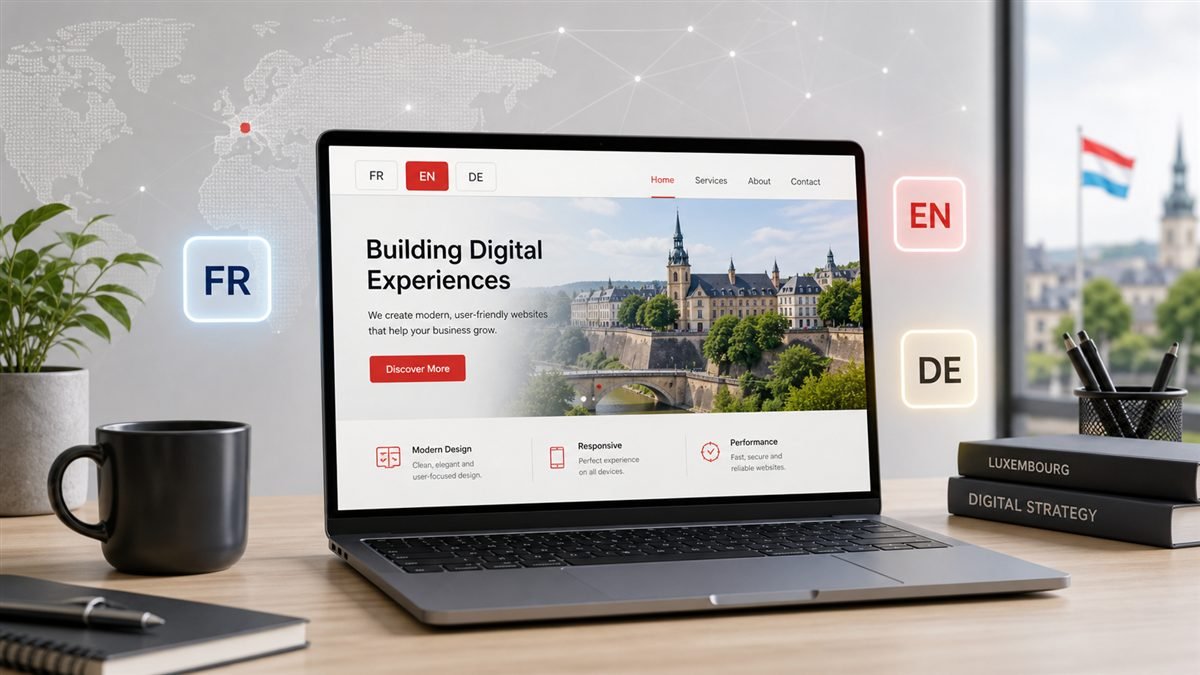
Nowhere in Europe makes the case for a multilingual website like Luxembourg. French, German, Luxembourgish and English are spoken every day, and your next customer might search in any of them. A site in one language quietly turns away everyone who thinks in another. After building multilingual sites for Luxembourg businesses since 2017, here is what actually works — and the mistakes that cost rankings and trust.
Which languages do you actually need?
Start with your customers, not with all four. Most local businesses do well with French + English: French is the lingua franca of daily commerce, English reaches the huge expat and cross-border community. German is valuable if you serve the north or German-speaking clients; Luxembourgish adds a real trust signal for local-first brands. You do not need every language — you need the two or three your buyers genuinely use.
Subfolders, not separate domains
Use clean language subfolders — yoursite.lu/fr/, /en/, /de/ — on one domain. It keeps all your SEO authority in one place, is far cheaper to maintain, and is what Google recommends. Avoid separate domains per language (expensive, splits your authority) and never auto-redirect by IP — let visitors choose and stay.
The hreflang tag is non-negotiable
hreflang tags tell Google which language version to show which searcher. Without them, your French and English pages compete against each other and Google may serve the wrong one. Done properly, a Luxembourger searching in French sees /fr/ and an expat searching in English sees /en/ — each ranking on its own merits. This single technical detail separates a real multilingual site from a half-built one.
Translate for humans, not with a plugin
Auto-translate plugins produce text that reads as foreign and damages trust — and Google can tell. Real translation, localised to how Luxembourgers actually phrase things, is what converts. Headlines, calls-to-action and trust copy matter most; get those written natively, not machine-flipped.
Keep the structure identical across languages
Every page should exist in every offered language, at a predictable URL, with a language switcher that takes you to the same page — not back to the homepage. A visitor who switches to English mid-article should land on the English version of that article. Broken switchers are the most common multilingual bug we fix.
What it costs and how long it takes
A multilingual build is not three times the price — the design and development are done once; you mostly pay for translation and the extra pages. Plan for professional translation per language and a slightly longer timeline. Build it multilingual from the start if you can; retrofitting languages later is always more work than doing it upfront.
The takeaway
In Luxembourg, language is not a feature — it is the difference between being found and being skipped. A properly built multilingual site (clean subfolders, correct hreflang, human translation, a working switcher) quietly doubles or triples the audience that can actually buy from you. We build trilingual and quad-lingual sites for Luxembourg businesses every month — tell us who your customers are and we will tell you exactly which languages will pay off.